Jayanagar 3rd Block East Bangalore-560011, Karnataka India

Insurance Case Study India: ₹58,729 Health Insurance Claim Rejection Overturned
Insurance Case Study India: ₹58,729 Health Insurance Claim Rejection Overturned
A health insurance claim rejection can become especially difficult for a family when an insurer questions whether hospitalisation was medically necessary.
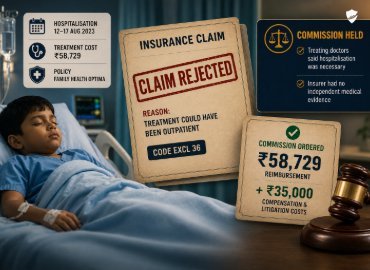
In this case, a child suffering from high fever and severe throat pain required hospital treatment. His father incurred ₹58,729 in medical expenses and subsequently submitted a health insurance claim.
The insurer rejected the claim, arguing that the child's condition did not require hospitalisation and could have been managed through outpatient treatment.
The dispute eventually reached the Kangra District Consumer Disputes Redressal Commission, where the child's medical records and the treating doctor's decision became crucial. The Commission ultimately overturned the rejection and ordered reimbursement of the medical expenses along with interest, compensation and litigation costs.
The Child's Hospitalisation Led to a ₹58,729 Claim
The dispute began after the child developed high fever and severe throat pain.
He was initially admitted to Zonal Hospital, Dharamshala. When his condition did not improve, he was shifted to City Hospital, Matour, Kangra, for further treatment.
At City Hospital, the child was diagnosed with acute fever with thrombocytopenia and transaminitis. He received treatment that included intravenous fluids and antibiotics and remained hospitalised until 17 August 2023.
His father incurred total medical expenses of ₹58,729 during the treatment. A hospitalisation insurance claim was subsequently submitted seeking reimbursement of these expenses.
However, instead of settling the claim, the insurer questioned whether inpatient hospitalisation had actually been required. This resulted in a health insurance claim dispute over the medical necessity of the treatment.
The Insurer Said Hospitalisation Was Not Medically Necessary
The insurer rejected the health insurance claim after its in-house medical team reviewed the case. According to the insurer's assessment, the child's condition could have been managed on an outpatient basis and did not require inpatient hospitalisation.
The insurer therefore relied on a policy exclusion concerning treatment or hospitalisation that was not considered medically necessary. This became the central issue in the medical insurance claim rejection.
The father disagreed with the decision because the child had already required admission at one hospital and was subsequently shifted to another hospital when his condition did not improve. The medical records also documented the child's diagnosis and treatment during hospitalisation.
The dispute therefore raised an important question: Should an insurer's retrospective assessment override the treating doctor's decision that a patient required hospitalisation?
The Treating Doctor's Decision Became Crucial to the Dispute
The medical evidence became particularly important when the matter reached the Consumer Commission. The Commission considered the circumstances under which the child had been admitted and the treatment he received.
It observed that the child had first been admitted to Zonal Hospital, Dharamshala, and was subsequently taken to City Hospital after his condition failed to improve.
The Commission gave importance to the decision made by the treating doctor, who had examined the patient and determined that hospitalisation was required. It also noted that the insurer had not filed an affidavit from a member of its medical team to substantiate the conclusion that the child's hospitalisation was unnecessary.
The Commission's reasoning highlighted an important distinction between a doctor treating a patient during an illness and an insurer subsequently reviewing the medical records while assessing a claim. The treating doctor's assessment therefore became a crucial factor in deciding the medical necessity insurance claim dispute.
The Consumer Commission Overturned the Claim Rejection
After examining the evidence, the Kangra District Consumer Disputes Redressal Commission disagreed with the insurer's decision. The Commission held that the treating doctor was in the appropriate position to determine whether the child required inpatient treatment rather than outpatient or home-based care.
It found the rejection of the claim to be wrongful and treated it as a deficiency in service. The insurer was directed to reimburse the medical expenses of ₹58,729 with interest at 9% per annum from the date of filing the complaint until realisation.
The Commission additionally awarded:
Excluding interest, these amounts totalled ₹93,729, or approximately ₹94,000.
The outcome turned what began as a ₹58,729 rejected hospitalisation claim into a significant consumer court decision concerning medical necessity and health insurance claim assessment.
What This Health Insurance Case Teaches Policyholders
This health insurance claim case study highlights the importance of medical documentation when an insurer questions whether hospitalisation was necessary. Hospitalisation decisions are based on several factors, including a patient's symptoms, diagnosis, response to previous treatment and clinical condition at the time.
For policyholders, preserving the complete medical record can therefore become crucial during a claim dispute. Important documents can include:
Policyholders should also carefully review the exact reason given when a health insurance claim rejection occurs. A rejected claim does not automatically mean that the policyholder has no further options. The rejection reason, policy wording and supporting medical evidence should be examined together before deciding what action to take.
The central lesson from this case is clear: when medical necessity is disputed, strong clinical documentation and the treating doctor's assessment can become crucial evidence.
Conclusion
A health insurance claim rejection can place an additional financial burden on a family that is already dealing with a medical emergency.
In this case, a child developed high fever and severe throat pain and was initially admitted to Zonal Hospital, Dharamshala. When his condition did not improve, he was shifted to City Hospital, Matour, Kangra, where he remained hospitalised until 17 August 2023. The total treatment expenses amounted to ₹58,729.
The insurer rejected the health insurance claim on the ground that the hospitalisation was not medically necessary and that the child could have been treated as an outpatient. However, the Kangra District Consumer Disputes Redressal Commission disagreed.
The Commission considered the child's medical records, his previous hospital admission and the treating doctor's decision that hospital treatment was required. It also noted that the insurer had not filed an affidavit from a member of its medical team to substantiate its conclusion that hospitalisation was unnecessary.
The Commission held that the treating doctor was in the appropriate position to decide whether the patient required hospitalisation. It therefore found the claim rejection wrongful and a deficiency in service.
The insurer was directed to reimburse the ₹58,729 medical expenses with 9% annual interest from the date of filing until realisation. In addition, the complainant was awarded ₹20,000 as compensation and ₹15,000 towards litigation costs. Together, the principal reimbursement, compensation and litigation costs amounted to ₹93,729—approximately ₹94,000—before applicable interest.
This health insurance claim case study highlights an important lesson for policyholders: medical records and treating doctors' recommendations can become crucial evidence when the medical necessity of hospitalisation is disputed.
If your health insurance claim has been rejected, do not assume that the rejection is necessarily the end of the matter. Review the reason for repudiation, your policy conditions and the medical evidence supporting your treatment before deciding your next step. Professional guidance can help you understand your coverage, documentation requirements and available options when dealing with a disputed health insurance claim.
Contact us today or visit BasketOption.insure, the leading insurance brokers in Bangalore, for your policy, claims review, and expert advisory services. Visit https://basketoption.insure/ or get in touch with our experts today to explore insurance plans that truly care about your needs.
Latest Posts










Our Experts

Frequently Asked Questions
?What was the ₹58,729 health insurance claim case about?
The case involved a child's hospitalisation for high fever and severe throat pain. His father incurred medical expenses of ₹58,729 and submitted a health insurance claim, which the insurer rejected on the ground that hospitalisation was not medically necessary.
?Why was the child hospitalised?
The child initially suffered from high fever and severe throat pain. He was later diagnosed with acute fever with thrombocytopenia and transaminitis and received hospital treatment, including intravenous fluids and antibiotics.
?How much did the hospital treatment cost?
The medical expenses involved in the claim totalled ₹58,729.
?Why did the insurer reject the health insurance claim?
The insurer's in-house medical team concluded that the child's condition could have been managed on an outpatient basis and that inpatient hospitalisation was not medically necessary.
?What policy exclusion did the insurer rely on?
The insurer relied on a policy exclusion concerning hospitalisation or treatment that was considered medically unnecessary or did not warrant inpatient care.
?Why did the Consumer Commission disagree with the insurer?
The Commission considered the child's medical records, earlier hospital admission and treating doctor's decision. It also noted that the insurer had not filed an affidavit from a member of its medical team supporting the conclusion that hospitalisation was unnecessary.
?Why was the treating doctor's opinion important?
The Commission considered the treating doctor to be in the appropriate position to determine whether the child's medical condition required hospitalisation rather than outpatient or home treatment.
?How much did the Consumer Commission award?
The insurer was directed to reimburse ₹58,729 with 9% annual interest from the date of filing until realisation. It was also directed to pay ₹20,000 as compensation and ₹15,000 towards litigation costs.
?Why is it called a ₹94,000 consumer court victory?
The ₹58,729 reimbursement, ₹20,000 compensation and ₹15,000 litigation costs total ₹93,729, which is approximately ₹94,000. The 9% interest payable on the reimbursement is additional.
?What should policyholders learn from this health insurance case?
Policyholders should preserve hospital bills, medical records, diagnostic reports, prescriptions, discharge summaries and treating doctors' recommendations. These documents can become important evidence when an insurer disputes whether hospitalisation was medically necessary.