Jayanagar 3rd Block East Bangalore-560011, Karnataka India

Insurance Case Study India: ₹48.26 Lakh Dacoity: Insurer Ordered to Pay
Insurance Case Study India: ₹48.26 Lakh Dacoity: Insurer Ordered to Pay
A money insurance claim can become complicated when an insurer alleges that the policyholder failed to follow security measures or breached policy conditions.
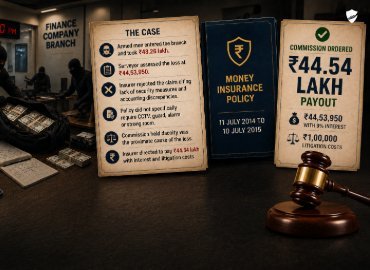
In this case, five or six armed men entered a finance company's branch during business hours and allegedly took away ₹48.26 lakh. The money had been collected through field operations and was being processed for remittance to a bank.
The finance company filed a claim under its money insurance policy, but the insurer rejected it, citing the absence of security measures such as a guard, CCTV and a strong chest, along with accounting discrepancies.
However, the insurer's own surveyor assessed the loss at ₹44,53,950. The dispute eventually reached the West Bengal State Consumer Disputes Redressal Commission, raising an important question: Can an insurer reject an entire claim for security measures that were never expressly required by the policy?
The ₹48.26 Lakh Dacoity Triggered a Money Insurance Claim
The incident occurred on 1 June 2015 at around 1:20 PM, when five or six armed men entered the finance company's branch. They took away approximately ₹48.26 lakh that had been collected through field operations and was being processed for remittance to a bank.
The company's money insurance policy was valid from 11 July 2014 to 10 July 2015, meaning the incident occurred during the policy period.
An FIR was registered under Section 395 of the Indian Penal Code. The police later arrested six people and recovered approximately ₹1.45 lakh and a pistol. A chargesheet was subsequently filed under Sections 395 and 412 of the IPC.
Following the loss, the finance company submitted a money insurance claim seeking recovery of the stolen amount. The insurer appointed a surveyor to investigate and assess the financial loss.
The Insurer Alleged Breach of Security Conditions
Despite the reported dacoity, the insurer rejected the claim on 17 July 2017. The insurer raised several concerns regarding the security arrangements at the branch. It pointed to the alleged absence of a:
The insurer also raised accounting concerns. There was a ₹3,72,050 difference between the cash book and the online collection report that the surveyor was unable to reconcile.
The finance company explained that collections were supported by machine-generated receipts. It also stated that cash received on 1 June had been recorded as a 31 May collection because of the month-end half-holiday.
The dispute therefore became more than a simple dacoity insurance claim. It turned into a question of whether the alleged security failures actually constituted an insurance policy breach capable of defeating the entire claim.
The Surveyor Assessed the Loss at ₹44.54 Lakh
An important part of the insurance claim dispute was the assessment conducted by the insurer-appointed surveyor. After examining the incident and financial records, the surveyor assessed the reconciled loss at ₹44,53,950, or approximately ₹44.54 lakh.
The full claim was around ₹48.26 lakh, but the ₹3,72,050 accounting difference could not be satisfactorily reconciled. The Consumer Commission ultimately accepted the surveyor-assessed amount rather than the entire amount originally claimed.
The Commission considered the practice of recording money received on 1 June as a 31 May transaction to be unsatisfactory. As a result, the unreconciled ₹3,72,050 was not included in the final payable amount.
The insurance surveyor assessment therefore became crucial in establishing the amount of loss that could be supported by the available records.
The Consumer Commission Examined the Claim Rejection
The West Bengal State Consumer Disputes Redressal Commission examined whether the insurer was justified in repudiating the entire claim. A central issue was whether CCTV, a security guard, an alarm or a particular type of strong room were actually required under the written terms of the money insurance policy.
The Commission concluded that the policy terms could not be expanded retrospectively to impose security requirements that were not expressly included in the contract. It also noted that the branch had shutters and grills and that the money was being processed during normal business hours.
Most importantly, the Commission treated the dacoity itself as the proximate cause of the loss. The insurer failed to establish a policy breach or demonstrate a sufficient connection between the alleged security omissions and the actual loss.
The Commission therefore found that rejecting the entire claim amounted to a deficiency in service. It directed the insurer to pay ₹44,53,950, subject to an adjustment concerning the ₹1.45 lakh recovered by police if the insurer could establish that the recovered amount had actually been restored to the finance company.
The Commission also awarded 9% annual interest from 17 July 2017 until payment, along with ₹1 lakh in litigation costs.
What This Insurance Case Teaches Businesses
This insurance claims case study provides an important lesson for businesses purchasing commercial insurance. Insurance claims should be assessed according to the actual terms, conditions, warranties and exclusions contained in the insurance contract.
An insurer cannot simply identify precautions that might have been desirable after an incident and automatically treat their absence as a policy breach. At the same time, businesses have an equally important responsibility to understand and comply with the requirements that are expressly included in their policies.
Companies handling significant amounts of cash should carefully review their money insurance policy, particularly provisions relating to cash at premises, cash in transit, security arrangements, policy limits and documentation requirements.
Businesses should also maintain accurate accounting records. In this case, the finance company did not receive the entire ₹48.26 lakh claimed because ₹3,72,050 could not be satisfactorily reconciled. The Commission instead relied on the surveyor's assessment of ₹44,53,950.
The lesson is therefore twofold: know exactly what your policy requires and maintain documentation capable of proving the full extent of your loss.
Conclusion
A money insurance claim can become complicated when an insurer alleges that the insured failed to comply with security requirements or other policy conditions.
In this case, a finance company's branch suffered an armed dacoity in which approximately ₹48.26 lakh was taken. The money had been collected through field operations and was being processed for remittance to a bank.
The insurer rejected the claim, citing the absence of a security guard, CCTV and a strong chest, along with accounting discrepancies. However, the Consumer Commission found that these security measures were not expressly required under the applicable policy terms.
The Commission also determined that the dacoity, rather than the alleged absence of additional security precautions, was the proximate cause of the loss.
At the same time, the entire ₹48.26 lakh claim was not allowed. A discrepancy of ₹3,72,050 remained unreconciled, while the insurer-appointed surveyor had assessed the supported loss at ₹44,53,950.
The insurer was therefore directed to pay ₹44,53,950, subject to the applicable recovery adjustment, along with 9% annual interest from 17 July 2017 until payment and ₹1 lakh in litigation costs.
This case highlights an important principle for businesses: insurance claim decisions should be based on the actual policy wording and supported evidence—not additional conditions introduced after a loss occurs.
If your business handles significant amounts of cash, carefully reviewing the scope, limits, exclusions and security conditions of your money insurance policy can help identify coverage gaps before a theft, robbery or dacoity occurs. Businesses should also maintain clear financial records and preserve policy documents, endorsements, surveyor reports, receipts and claim correspondence.
Contact us today or visit BasketOption.insure, the leading insurance brokers in Bangalore, for your policy, claims review, and expert advisory services. Visit https://basketoption.insure/ or get in touch with our experts today to explore insurance plans that truly care about your needs.
Latest Posts










Our Experts


Frequently Asked Questions
?What was the ₹48.26 lakh dacoity insurance case about?
The case involved a finance company's branch where five or six armed men allegedly took away approximately ₹48.26 lakh that had been collected through field operations and was being processed for bank remittance.
?When did the dacoity take place?
The incident occurred on 1 June 2015 at approximately 1:20 PM.
?Was the money insurance policy active at the time?
Yes. The policy was valid from 11 July 2014 to 10 July 2015, covering the date of the incident.
?Why did the insurer reject the money insurance claim?
The insurer cited the absence of a security guard, CCTV and a strong chest, along with accounting issues, as grounds for rejecting the claim.
?How much did the insurance surveyor assess the loss at?
The insurer-appointed surveyor assessed the loss at ₹44,53,950, approximately ₹44.54 lakh.
?Why wasn't the entire ₹48.26 lakh claim awarded?
There was an unreconciled difference of ₹3,72,050 between the cash book and online collection report. The Commission accepted the surveyor's reconciled assessment rather than the entire amount claimed.
?What did the Commission say about CCTV and security guards?
The Commission found that the written policy terms could not be expanded to require CCTV, a security guard, an alarm or a particular strong room when those measures were not expressly required under the policy.
?What was considered the proximate cause of the loss?
The Commission considered the armed dacoity itself to be the proximate cause of the financial loss rather than the alleged security lapses.
?How much was the insurer ultimately ordered to pay?
The insurer was directed to pay ₹44,53,950, subject to adjustment concerning the ₹1.45 lakh recovered by police if it could be established that this money had actually been restored to the complainant. The award also carried 9% annual interest from 17 July 2017 until payment and ₹1 lakh in litigation costs.
?What should businesses learn from this money insurance claim case?
Businesses should carefully understand the exact requirements of their insurance policies and maintain detailed financial and claim records. If a claim is rejected for an alleged policy breach, the rejection should be compared with the actual written policy conditions and supporting evidence.