Jayanagar 3rd Block East Bangalore-560011, Karnataka India

Insurance Case Study India: ₹2.85 Lakh Cancer Claim Rejected Over Two Injections
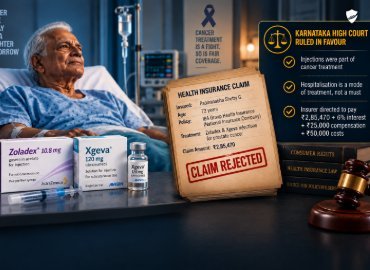
Insurance Case Study India: ₹2.85 Lakh Cancer Claim Rejected Over Two Injections
A health insurance claim rejection can become particularly difficult when a treatment is medically necessary but does not fit a narrow interpretation of hospitalisation.
This case involved a 72-year-old retired bank officer suffering from Stage IV prostate cancer. He was undergoing cancer treatment, including chemotherapy, and his doctors prescribed two injections—Zoladex and Xgeva—as part of his continuing treatment.
While several of his hospitalisation-related medical expenses were reimbursed, the insurer refused to reimburse ₹2,85,470 spent on these injections.
The insurer argued that the injections did not require hospitalisation and therefore amounted to outpatient treatment that was outside the policy coverage.
The dispute eventually reached the Karnataka High Court, raising an important question: can medically prescribed treatment be denied merely because hospitalisation was not required?
The Cancer Patient Claimed ₹2.85 Lakh for Two Injections
Padmanabha Shetty G., a retired bank officer, was covered under a health insurance scheme with annual coverage of ₹9 lakh for the relevant policy period.
He was suffering from Stage IV carcinoma of the prostate and had undergone treatment, including chemotherapy, at a hospital in Bengaluru.
As part of his continuing cancer management, his doctors advised him to take two injections—Zoladex and Xgeva—once every three months. The injections were prescribed as part of the ongoing management of his cancer.
Several components of his medical expenditure were reimbursed by the insurer. However, the amounts spent on Zoladex and Xgeva were not reimbursed.
The policyholder eventually claimed ₹2,85,470 towards these unpaid medical expenses and approached the Permanent Lok Adalat in Mangaluru.
The Insurer Rejected the Claim Over Hospitalisation
The insurer's main argument was that administering Zoladex and Xgeva did not require hospitalisation.
According to the insurer, the policy provided coverage for hospitalisation and qualifying day-care treatment, while the injections amounted to outpatient treatment.
The insurer relied on the definitions of “Day Care Treatment” and “Hospitalisation” contained in the policy. It argued that the injections were not administered under general or local anaesthesia and did not satisfy the requirements for treatment that would qualify as a covered day-care procedure.
This became the central issue in the health insurance claim dispute.
The Permanent Lok Adalat ultimately directed reimbursement of the medical expenses, but the insurer challenged that decision before the Karnataka High Court.
The Court Found the Injections Were Part of Cancer Treatment
The Karnataka High Court examined the relationship between the injections and the underlying insured disease.
An important fact was that the insurer did not dispute that the patient had Stage IV prostate cancer or that he was undergoing treatment for the disease. The insurer had also reimbursed expenses relating to his hospitalisation and cancer treatment.
The dispute was specifically about the Zoladex and Xgeva injections. The Court noted that the two injections had been prescribed as part of the continuing treatment and management of the patient's prostate cancer.
Zoladex was being used as hormonal therapy in the management of prostate cancer, while Xgeva was being used in relation to skeletal complications associated with advanced cancer.
The fact that these treatments could be administered without prolonged hospitalisation did not, by itself, disconnect them from the treatment of the insured disease.
The case therefore became about more than whether the patient had technically remained inside a hospital for a particular period. The key issue was whether the treatment was medically connected to the disease for which he was already receiving covered treatment.
The Karnataka High Court Upheld the ₹2.85 Lakh Claim
The Karnataka High Court rejected the insurer's restrictive interpretation in the circumstances of the case.
The Court recognised that developments in medical science can allow certain treatments to be safely administered without unnecessary hospitalisation. It found that the absence of hospitalisation could not, by itself, determine whether treatment was connected with the insured disease.
The Court upheld the Permanent Lok Adalat's decision directing reimbursement of ₹2,85,470 towards the Zoladex and Xgeva injections. The reimbursement carried 6% annual interest from the date of the petition until realisation.
The Permanent Lok Adalat had also awarded ₹25,000 as compensation for inconvenience caused to the policyholder.
The High Court dismissed the insurer's writ petition and additionally imposed ₹50,000 in costs, payable to the insured.
The insurer was directed to pay the amounts awarded by the Permanent Lok Adalat along with up-to-date interest within the period specified by the Court.
What This Health Insurance Claim Case Teaches Policyholders
This health insurance claim case study provides an important lesson about modern medical treatment and insurance coverage.
Medical treatment is constantly evolving. Procedures and therapies that may once have required lengthy hospitalisation can sometimes now be administered safely through shorter hospital visits, day-care procedures or other medically appropriate settings.
Policyholders should therefore carefully examine the reason given when a health insurance claim rejection is based on hospitalisation requirements.
The treating doctor's prescription, medical records, treatment history and connection between the disputed treatment and the insured disease can become important evidence.
At the same time, every health insurance policy has its own terms, definitions, exclusions and coverage conditions. This judgment should therefore not be interpreted to mean that every outpatient treatment is automatically covered. The specific policy wording and medical circumstances remain important.
The broader lesson is that a claim should be evaluated based on the actual treatment, its medical necessity, its connection with the insured disease and the applicable policy terms—not merely on whether an unnecessary hospital stay occurred.
Conclusion
This health insurance claim rejection highlights how changes in medical treatment can create disputes over traditional policy definitions.
The policyholder was undergoing treatment for Stage IV prostate cancer, and his doctors prescribed Zoladex and Xgeva as part of his continuing cancer management.
Although the insurer reimbursed several hospitalisation-related expenses, it refused to reimburse ₹2,85,470 spent on these injections because they did not require hospitalisation.
The Karnataka High Court did not accept this restrictive approach in the circumstances of the case. The Court recognised that the injections were connected to the continuing treatment of the insured disease and upheld the reimbursement awarded by the Permanent Lok Adalat.
The insurer's challenge was dismissed, and the reimbursement of ₹2,85,470 with interest was sustained. The High Court also imposed ₹50,000 in costs on the insurer.
For policyholders, the case demonstrates why medical prescriptions, treatment records, policy documents and claim rejection letters should be carefully preserved.
If a treatment is rejected because it was administered without hospitalisation, the actual medical purpose of that treatment and its connection with the insured disease may become important when the claim is reviewed.
A rejected health insurance claim can be difficult to understand, particularly when the dispute involves hospitalisation requirements, day-care treatment, outpatient procedures or interpretation of policy wording.
If your health insurance claim is rejected, review the policy terms, treating doctor's prescription, medical records, hospital documents and claim rejection letter carefully before deciding the next step.
Contact us today or visit BasketOption.insure, the leading insurance brokers in Bangalore, for your policy, claims review, and expert advisory services. Visit https://basketoption.insure/ or get in touch with our experts today to explore insurance plans that truly care about your needs.
Latest Posts












Our Experts


Frequently Asked Questions
?What was the ₹2.85 lakh health insurance claim about?
The case involved a Stage IV prostate cancer patient seeking reimbursement of ₹2,85,470 spent on Zoladex and Xgeva injections prescribed as part of his continuing cancer treatment.
?Why did the insurer refuse to reimburse the injections?
The insurer argued that the injections did not require hospitalisation and therefore constituted outpatient treatment outside the relevant policy coverage.
?Which injections were involved in the case?
The disputed treatment involved Zoladex and Xgeva, which had been prescribed as part of the patient's continuing prostate cancer management.
?What type of cancer did the policyholder have?
The policyholder was suffering from Stage IV prostate cancer.
?Had the insurer paid for the patient's other cancer treatment?
Yes. Several medical expenses relating to the patient's hospitalisation and treatment had been reimbursed. The dispute concerned the expenses incurred specifically for Zoladex and Xgeva.
?What did the Permanent Lok Adalat decide?
The Permanent Lok Adalat directed reimbursement of ₹2,85,470, along with interest, and also awarded compensation for the inconvenience caused to the policyholder.
?What did the Karnataka High Court decide?
The Karnataka High Court upheld the Permanent Lok Adalat's award and dismissed the insurer's challenge.
?Did the High Court impose costs on the insurer?
Yes. The Karnataka High Court imposed ₹50,000 in costs on the insurer, payable to the insured.
?Does this judgment mean all outpatient treatments are covered by health insurance?
No. Coverage depends on the specific policy wording and circumstances. The judgment concerned treatment medically connected to the insured disease and should not be treated as meaning that every outpatient expense is automatically covered.
?What is the main lesson from this health insurance claim case?
A treatment should not be viewed only through the question of whether hospitalisation occurred. Its medical necessity, connection with the insured disease, treatment records and applicable policy wording can all become important when reviewing a health insurance claim rejection.