Jayanagar 3rd Block East Bangalore-560011, Karnataka India

Insurance Case Study India: ₹48,251 Health Claim Rejected Over Google Timeline
Insurance Case Study India: ₹48,251 Health Claim Rejected Over Google Timeline
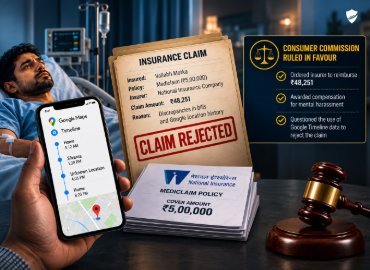
A health insurance claim rejection is usually based on policy conditions, medical records, exclusions or discrepancies in claim documents. But in this unusual case, a policyholder's Google Maps Timeline became part of the reason for rejecting his hospitalisation claim.
Vallabh Motka, a resident of Silvassa, was hospitalised for viral pneumonia from 11 September to 14 September 2024. After treatment, he submitted a health insurance claim for ₹48,251.
The insurer rejected the claim after raising discrepancies in the claim documents and relying, among other things, on the policyholder's Google Timeline, which allegedly did not show the hospital location during the period of hospitalisation.
However, medical and investigation records supported the fact that the patient had actually been treated as an indoor patient.
The dispute eventually reached the Valsad Consumer Disputes Redressal Commission, which ruled in favour of the policyholder and directed the insurer to settle the claim.
The Policyholder Filed a ₹48,251 Hospitalisation Claim
The policyholder had purchased a mediclaim policy with coverage of approximately ₹6.52 lakh.
In September 2024, he developed viral pneumonia and was admitted to Arham Hospital in Silvassa. According to the case records, he was admitted as an indoor patient on 11 September 2024 and remained under treatment until his discharge on 14 September 2024.
Following the hospitalisation, he submitted a ₹48,251 health insurance claim seeking reimbursement for the medical expenses. The policyholder had hospital records and supporting documents relating to his treatment.
However, instead of settling the claim, the insurer raised questions about the hospitalisation and the supporting documents.
One particularly unusual piece of information became central to the dispute—the policyholder's Google Maps Timeline.
The Insurer Questioned His Google Location History
In its repudiation, the insurer cited discrepancies involving bills, indoor case papers and supporting documents. Its investigation also examined the policyholder's Google Timeline.
According to the insurer's position, the hospital location was not visible on the patient's Google Maps Timeline during the period in which he claimed to have been hospitalised. This created doubt over whether the hospitalisation had actually taken place as claimed.
The policyholder disagreed with the health insurance claim rejection and made attempts to have the decision reconsidered. After those efforts failed, he approached the consumer forum in March 2025.
His case relied on medical documentation, including a certificate from the treating doctor, to establish that he had genuinely undergone treatment at the hospital.
The dispute therefore raised an unusual question: how much weight should digital location history carry when medical and hospital records support the patient's hospitalisation?
Hospital Records Supported the Patient's Admission
The consumer forum examined the evidence surrounding the disputed hospital stay.
Importantly, the investigation report itself confirmed that the policyholder had been treated as an indoor patient between 11 and 14 September 2024 for viral pneumonia. The hospital had also been visited during the investigation and its records were examined.
The treating doctor's certificate further supported the patient's case that the treatment had been carried out under medical supervision. This evidence became important because it directly addressed whether the hospitalisation was genuine.
The consumer forum found that the discrepancy relating to the Google Timeline had been wrongly relied upon while assessing the claim.
The case demonstrates why a hospitalisation insurance claim should be assessed using reliable medical evidence and relevant claim documents rather than treating one piece of digital information as conclusive.
Google Timeline can be affected by factors such as device settings, location permissions and connectivity. Its absence alone does not necessarily establish that a person was never present at a particular location.
The Consumer Forum Ordered Payment of ₹48,251
After examining the available evidence, the Valsad Consumer Disputes Redressal Commission ruled in favour of the policyholder.
The forum directed the insurer to pay the ₹48,251 health insurance claim. The amount was ordered to be paid with 8% interest. The insurer was also directed to compensate the policyholder for the difficulties caused by the claim dispute.
The decision highlighted the importance of the medical and hospital evidence supporting the policyholder's admission. The investigation had confirmed the hospitalisation, and the treating doctor's certificate supported the treatment records.
The Google Timeline discrepancy was therefore not sufficient to defeat the claim in the circumstances of this case.
For policyholders, the outcome provides an important reminder that a health insurance claim rejection should be examined against the complete evidence available rather than accepted without review.
What This Health Insurance Claim Case Teaches Policyholders
This health insurance claim case study offers several important lessons.
First, preserve all documents relating to a hospitalisation. Discharge summaries, hospital bills, prescriptions, diagnostic reports, payment receipts, indoor case papers and treating doctor's certificates can become important if an insurer later questions whether treatment actually occurred.
Second, understand the reason given for claim rejection. If an insurer identifies discrepancies, policyholders should compare those allegations against their actual medical and hospital records.
Third, digital information should be viewed in context. Location-history data may form part of an investigation, but the reliability and relevance of that information should be considered alongside medical evidence and other records.
Finally, a rejected claim does not necessarily mean that the matter cannot be reviewed. Depending on the circumstances, policyholders may seek clarification from the insurer and use the appropriate grievance or dispute-resolution mechanisms available to them.
Conclusion
This health insurance claim rejection demonstrates how digital information can become part of modern insurance claim investigations.
The policyholder was hospitalised for viral pneumonia from 11 September to 14 September 2024 and subsequently submitted a claim for ₹48,251.
The insurer rejected the claim after raising discrepancies in the supporting records and relying, among other things, on the patient's Google Timeline, which allegedly did not show his presence at the hospital.
However, the available evidence told a different story. The investigation itself confirmed that the policyholder had been treated as an indoor patient, while the hospital records and treating doctor's certificate supported the hospitalisation.
The Valsad Consumer Disputes Redressal Commission ultimately directed the insurer to pay the ₹48,251 claim with 8% interest.
The broader lesson for policyholders is important. When a hospitalisation claim is questioned, medical records, hospital documentation, treating doctor's certificates and other supporting evidence should be carefully preserved.
A health insurance claim rejection should be evaluated against the complete evidence surrounding the treatment rather than any single piece of information in isolation.
A rejected health insurance claim can become complicated when an insurer raises questions about hospitalisation, medical records, documentation or information collected during a claim investigation.
If your claim has been rejected, carefully review the rejection letter against your policy wording, discharge summary, hospital records, bills, prescriptions and other supporting documents. Understanding exactly why the claim was rejected is the first step towards identifying whether further review may be appropriate.
Contact us today or visit BasketOption.insure, the leading insurance brokers in Bangalore, for your policy, claims review, and expert advisory services. Visit https://basketoption.insure/ or get in touch with our experts today to explore insurance plans that truly care about your needs.
Latest Posts








Our Experts


Frequently Asked Questions
?What was the ₹48,251 health insurance claim case about?
The case involved a Silvassa resident whose ₹48,251 hospitalisation claim was rejected after the insurer raised discrepancies that included his Google Timeline not showing the hospital location during the claimed admission period.
?Why was the policyholder hospitalised?
He was admitted to hospital for treatment of viral pneumonia.
?How long was the patient hospitalised?
The records showed that he was treated as an indoor patient from 11 September to 14 September 2024.
?Why did the insurer reject the health insurance claim?
The insurer raised discrepancies involving bills, indoor case papers and supporting documents. Its investigation also relied on a Google Timeline discrepancy relating to the patient's location during the hospitalisation period.
?What was unusual about the Google Timeline evidence?
The insurer's investigation found that the hospital location was allegedly not visible in the patient's Google Maps Timeline during the period he said he was hospitalised.
?What evidence supported the patient's hospitalisation?
The investigation report, hospital records and treating doctor's certificate supported the fact that the policyholder had been treated as an indoor patient.
?What did the consumer forum decide?
The Valsad Consumer Disputes Redressal Commission ruled in favour of the policyholder and directed the insurer to settle the claim.
?How much was the insurer directed to pay?
The insurer was directed to pay the ₹48,251 claim amount with 8% interest.
?Can Google Location History alone prove whether someone was hospitalised?
Location history should not automatically be treated as conclusive evidence of whether a hospitalisation occurred. Medical records, hospital documentation, investigation findings and other relevant evidence should also be considered.
?What is the main lesson from this health insurance claim case?
Policyholders should preserve complete hospital and medical documentation. If a claim is rejected because of alleged inconsistencies, the insurer's reasons should be compared carefully with the actual medical evidence before determining the next step.