Jayanagar 3rd Block East Bangalore-560011, Karnataka India

Insurance Case Study India: 100% Disability: Supreme Court Awards ₹3.77 Crore
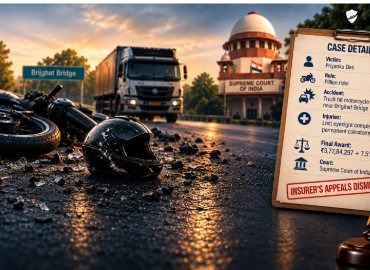
Insurance Case Study India: 100% Disability: Supreme Court Awards ₹3.77 Crore
A serious road accident can change a person's life permanently. Beyond immediate medical expenses, catastrophic injuries can affect independence, employment, future earning capacity and the need for lifelong care.
This motor accident compensation claim involved Priyanka Das, who suffered devastating injuries after a truck collided with the motorcycle on which she was travelling as a pillion rider.
The accident resulted in multiple severe injuries that ultimately left her completely blind and dependent on significant medical and workplace support.
Although she continued to remain employed, a major question arose: should continued employment mean that her loss of earning capacity was less than 100%?
The dispute eventually reached the Supreme Court, which examined the real impact of her disabilities on her future earning capacity and enhanced the compensation to ₹3,77,84,297.
The case provides an important example of how functional disability compensation can be assessed in a serious motor accident claim.
The Truck Crash Caused Life-Changing Injuries
The accident occurred on 10 April 2011.
Priyanka Das was travelling as a pillion rider on a motorcycle driven by Sushant Prabhakaran when a truck struck the motorcycle. Sushant died in the accident, while Priyanka suffered catastrophic injuries.
Her injuries and their long-term consequences ultimately included complete loss of eyesight, serious consequences arising from pelvic injuries and the need for a permanent colostomy stoma.
The accident therefore created consequences extending far beyond the initial hospitalisation and medical treatment.
Priyanka pursued a motor accident compensation claim seeking compensation for the financial and non-financial consequences of her injuries.
The compensation proceedings had to consider several factors, including medical expenses, disability, future earning capacity, attendant requirements, future treatment, pain and suffering and the impact of the injuries on her future life.
The Dispute Was Over Disability and Earning Capacity
One of the most important issues in the case was the assessment of Priyanka's disability and its effect on her ability to earn.
The case was unusual because despite suffering catastrophic injuries, Priyanka continued to remain employed. However, continued employment did not tell the entire story.
Her ability to perform her work depended upon significant accommodations, including specialised software, flexible working arrangements and support provided by her employer.
This raised an important question for permanent disability compensation: Should disability be assessed simply by looking at whether the injured person still has a job, or should the court examine whether that person can realistically compete and earn in the open employment market?
The Supreme Court considered the practical effect of Priyanka's disabilities rather than relying only on the fact that she remained employed. This distinction became central to calculating her loss of future earning capacity.
The Supreme Court Recognised 100% Functional Disability
A multidisciplinary Medical Board assessed Priyanka as having 100% permanent physical impairment of the whole body.
The Supreme Court considered this medical assessment along with the practical consequences of her injuries. Although she remained employed, the Court recognised that her ability to continue working was supported by exceptional workplace accommodations.
The fact that an employer had made special arrangements to enable an injured employee to continue working did not necessarily establish that the employee retained the same earning capacity in the broader employment market.
This distinction between physical disability and functional disability compensation is important in motor accident cases. Functional disability considers how an injury actually affects a person's ability to perform work and earn an income.
The same physical disability can affect different people differently depending on their profession, skills and nature of employment.
In Priyanka's case, the Supreme Court accepted 100% functional disability for calculating her loss of future earning capacity.
The Compensation Was Enhanced to ₹3.77 Crore
After reassessing the impact of the injuries, the Supreme Court recalculated the compensation.
For the loss of future earning capacity, the Court considered 100% disability, added 50% towards future prospects and applied a multiplier of 16. This resulted in ₹2,42,08,416 being awarded under the head of loss of future earning capacity alone.
The overall compensation also covered several other consequences of the accident, including:
The Supreme Court ultimately fixed the total motor accident compensation at ₹3,77,84,297. It also directed payment of 7.5% interest per annum from the date of the claim petition until realisation.
The decision demonstrates that compensation for catastrophic injuries is not limited to reimbursement of immediate medical bills. Courts may also have to consider the long-term economic and personal consequences of permanent disability.
What This Motor Accident Compensation Case Teaches
This motor accident claim case study highlights several important lessons for accident victims and their families.
First, disability should not always be understood only as a medical percentage. The practical effect of an injury on a person's profession, independence and ability to earn can become extremely important when determining compensation.
Second, continued employment does not automatically mean that earning capacity has remained unaffected. If an injured person can continue working only because of specialised technology, flexible working arrangements or exceptional support from an employer, these circumstances may need to be considered while assessing future earning capacity.
Third, medical evidence can play a crucial role in a motor accident disability claim. Disability certificates, specialist assessments, treatment records and evidence showing long-term medical requirements can help establish the actual impact of injuries. Income records and employment-related evidence can also become important when calculating loss of future earnings.
Finally, catastrophic injuries can create expenses and financial consequences that continue for decades. A comprehensive compensation assessment may therefore need to consider not only immediate medical costs but also future treatment, attendant requirements, loss of earning capacity and the broader impact on the injured person's quality of life.
Conclusion
This motor accident compensation claim demonstrates how courts may assess disability by considering its actual impact on a person's life, independence and ability to earn rather than looking only at whether the claimant continues to hold a job.
The accident occurred on 10 April 2011, when a truck struck the motorcycle on which Priyanka Das was travelling as a pillion rider. Sushant Prabhakaran, who was riding the motorcycle, died in the accident, while Priyanka suffered catastrophic and permanent injuries.
Her injuries ultimately included complete loss of eyesight, serious consequences of pelvic injuries and the need for a permanent colostomy stoma.
A crucial issue in the compensation dispute was her functional disability. Although Priyanka continued to remain employed, her ability to work depended on specialised software, flexible working arrangements and significant support from her employer.
The Supreme Court considered the latest Medical Board assessment, which certified 100% permanent physical impairment of the whole body. The Court recognised that continued employment under exceptional accommodations did not necessarily reflect the claimant's ability to compete and earn in the open job market.
Her loss of future earning capacity was consequently recalculated on the basis of 100% disability, 50% future prospects and a multiplier of 16.
The Supreme Court ultimately fixed the total compensation at ₹3,77,84,297, together with 7.5% annual interest from the date of the claim petition until realisation.
The judgment highlights an important principle in permanent disability compensation: the impact of an injury on actual earning capacity can be more important than the simple fact that the injured person continues to be employed.
For accident victims and their families, proper medical evidence, income records, disability assessments and documentation of long-term care requirements can therefore become extremely important when pursuing a motor accident compensation claim.
A serious road accident can create financial consequences that continue for years through medical expenses, loss of earning capacity, rehabilitation costs, attendant requirements and other long-term needs. When dealing with a major motor accident or disability-related claim, carefully reviewing the applicable insurance coverage, medical evidence, claim documentation and compensation calculations can be important.
Contact us today or visit BasketOption.insure, the leading insurance brokers in Bangalore, for your policy, claims review, and expert advisory services. Visit https://basketoption.insure/ or get in touch with our experts today to explore insurance plans that truly care about your needs.
Latest Posts













Our Experts


Frequently Asked Questions
?What was the ₹3.77 crore Supreme Court motor accident case about?
The case involved Priyanka Das, who suffered catastrophic injuries after a truck struck the motorcycle on which she was travelling as a pillion rider. The Supreme Court ultimately awarded her ₹3,77,84,297 in compensation.
?When did the truck accident occur?
The accident occurred on 10 April 2011.
?What injuries did Priyanka Das suffer?
She suffered multiple severe injuries that ultimately resulted in complete blindness, serious consequences of pelvic injuries and the need for a permanent colostomy stoma.
?Was Priyanka Das assessed as having 100% disability?
Yes. A multidisciplinary Medical Board assessed her as having 100% permanent physical impairment of the whole body. The Supreme Court considered this assessment while recalculating her loss of future earning capacity.
?Why was her continued employment important in the case?
Although Priyanka continued to work, she depended on specialised software, flexible working arrangements and substantial workplace accommodations. The Court considered whether this employment accurately reflected her ability to compete and earn in the open job market.
?What is functional disability in a motor accident claim?
Functional disability considers how a person's injuries affect their actual ability to perform work and earn. Its impact can differ depending on the claimant's occupation, skills and circumstances.
?How much was awarded for loss of future earning capacity?
The Supreme Court calculated ₹2,42,08,416 towards loss of future earning capacity based on 100% disability, 50% future prospects and a multiplier of 16.
?What was the total compensation awarded by the Supreme Court?
The total compensation was ₹3,77,84,297.
?Was interest awarded on the compensation?
Yes. The Supreme Court awarded 7.5% interest per annum from the date of the claim petition until the amount is realised.
?What is the key lesson from this motor accident compensation case?
The case shows that disability compensation should consider the real impact of injuries on a person's earning capacity and future life. Continued employment alone may not establish that earning capacity remains unaffected, particularly when the claimant can work only because of exceptional accommodations.