Jayanagar 3rd Block East Bangalore-560011, Karnataka India

Insurance Case Study India: ₹8 Lakh Life Insurance Claim Rejected for Concealment
Insurance Case Study India: ₹8 Lakh Life Insurance Claim Rejected for Concealment
A life insurance claim rejection can have serious financial consequences for a family, especially when the dispute begins after the death of the insured.
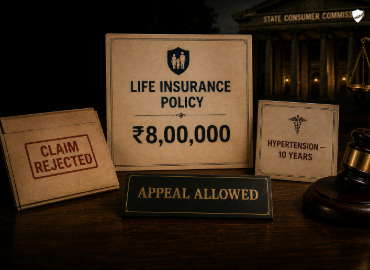
In this case, Jagdish Prasad Banjare obtained a life insurance policy with a sum assured of ₹8 lakh on 28 October 2018. Around six months later, he became ill and died during treatment on 2 May 2019.
His wife, Rukmani Banjare, subsequently submitted a claim under the policy. However, the insurer investigated the early death claim and discovered medical records indicating that the insured had suffered from hypertension for at least 10 years and had been taking regular medication.
The insurer eventually rejected the claim, alleging suppression of material facts in the life insurance proposal form.
The dispute raised an important question: Can non-disclosure of a long-standing medical condition justify a life insurance claim rejection?
The ₹8 Lakh Life Insurance Claim Was Rejected
Jagdish Prasad Banjare obtained a life insurance policy on 28 October 2018 with a sum assured of ₹8 lakh.
On 29 April 2019, he became ill and was taken to O.P. Jindal Hospital & Research Centre in Raigarh. When his condition did not improve, he was shifted to Shri Balaji Hospital in Raipur.
He died during treatment on 2 May 2019, while the life insurance policy was still in force.
His wife, who was the nominee under the policy, submitted a life insurance claim seeking the ₹8 lakh sum assured.
Because the insured died approximately six months after commencement of the policy, the insurer treated it as an early death claim and investigated it.
Following the investigation, the insurer repudiated the claim on 21 October 2020, alleging that the insured had concealed information about his medical history when purchasing the policy.
This life insurance claim repudiation eventually resulted in a consumer dispute.
Medical Records Revealed a 10-Year History of Hypertension
The insured's medical records became one of the most important pieces of evidence in the case.
The treatment papers from O.P. Jindal Hospital & Research Centre recorded his past medical history as "HTN 10 years" and also stated that he was on regular medication.
Another treatment record from Shri Balaji Institute of Medical Science referred to "HTN 15 years" and ongoing treatment.
The State Commission considered these records together and concluded that the insured had suffered from hypertension for at least 10 years before his death.
The medical evidence relating to his death was also considered.
The death certificate recorded the cause of death as CVA Ischemic Stroke with HTN with Sepsis. Another medical certificate referred to cardio-respiratory arrest, CVA ischemic stroke, hypertension and sepsis.
The Commission therefore concluded that hypertension was not merely an unrelated medical condition in the background of the case.
The Proposal Form Did Not Disclose the Medical Condition
The next important issue was the life insurance proposal form completed when the policy was purchased.
The Commission examined the answers given to questions concerning the insured's personal and medical history.
Relevant questions had been answered "No," while his general health had been described as "good."
Importantly, there was a specific question concerning hypertension or high blood pressure, which had also been answered negatively.
This became central to the insurer's argument.
If the medical records were correct, the insured had been suffering from hypertension for many years while the proposal form indicated that he did not have the condition.
The complainant argued that the proposal form had been completed by the insurer's agent.
However, the State Commission noted that the proposal form carried the insured's signature and that the authenticity of the signature was not disputed.
It therefore concluded that material information concerning the insured's medical history had been suppressed when the insurance policy was obtained.
The State Commission Examined the Concealment Dispute
The dispute initially went before the District Consumer Disputes Redressal Commission.
The District Commission partly allowed the complaint and directed the insurer to pay the ₹8 lakh sum assured with 6% annual interest from the date of the complaint.
It also awarded ₹5,000 towards mental agony and ₹2,000 towards litigation costs.
The insurance company appealed against that decision before the Chhattisgarh State Consumer Disputes Redressal Commission.
The State Commission examined the medical records, death certificate, proposal form and circumstances surrounding the insurance claim concealment dispute.
It concluded that the insured had failed to disclose material information concerning his long-standing hypertension.
The Commission also considered the claim under Section 45 of the Insurance Act, 1938, noting that the insured had died around six months after commencement of the policy and the claim had therefore been investigated as an early death claim.
Ultimately, the State Commission found no deficiency in service in the insurer's decision to repudiate the claim.
It overturned the District Commission's order and dismissed the complaint.
Why Accurate Medical Disclosure Matters in Life Insurance
This life insurance claim case study highlights why medical disclosure is a critical part of buying life insurance.
Insurance companies use information provided in proposal forms to evaluate risk and decide whether to issue a policy and on what terms.
Medical conditions, previous diagnoses, ongoing medication and treatment history can therefore be material to the underwriting process.
In this case, the State Commission concluded that the long-standing hypertension should have been disclosed because the proposal form specifically asked about hypertension and high blood pressure.
The case also demonstrates why policy buyers should personally review their proposal forms.
Even when an insurance agent or another person assists in completing the paperwork, the proposer should check every answer before signing the document.
The simple lesson is: never hide or overlook medical information when an insurance proposal specifically asks for it.
Accurate disclosure gives the insurer an opportunity to assess the actual risk and can help prevent serious disputes when a family eventually needs to make a claim.
Conclusion
Life insurance claim rejection disputes can become particularly significant when they involve the non-disclosure of a pre-existing medical condition at the time of purchasing the policy.
In this case, Jagdish Prasad Banjare obtained a life insurance policy with a sum assured of ₹8 lakh on 28 October 2018. He subsequently became ill and died during treatment on 2 May 2019, approximately six months after the policy commenced.
His wife, Rukmani Banjare, filed a claim under the life insurance policy.
The insurer investigated the early death claim and relied on medical records indicating that the insured had suffered from hypertension for at least 10 years and had been taking regular medication. Another hospital record referred to a 15-year history of hypertension.
However, relevant questions in the proposal form—including one specifically concerning hypertension or high blood pressure—had been answered negatively.
The State Commission considered this information material to the insurance contract and concluded that the insured had suppressed information about his medical history when obtaining the policy.
Although the District Commission had earlier directed the insurer to pay the ₹8 lakh sum assured with interest and additional compensation, the State Commission overturned that decision and dismissed the complaint.
This case highlights a critical lesson: medical disclosure at the proposal stage is not a formality.
Health conditions, ongoing medication, previous treatment and other information specifically requested by an insurer should be disclosed accurately. Material non-disclosure can potentially result in a future insurance claim being repudiated.
Before purchasing life insurance, make sure your proposal form accurately reflects your medical history, existing health conditions and ongoing treatment.
If someone else assists you in completing the proposal form, review every answer carefully before signing it. Accurate disclosure can help reduce disputes when your family eventually needs to make a claim.
Contact us today or visit BasketOption.insure, the leading insurance brokers in Bangalore, for your policy, claims review, and expert advisory services. Visit https://basketoption.insure/ or get in touch with our experts today to explore insurance plans that truly care about your needs.
Latest Posts













Our Experts


Frequently Asked Questions
?What was the ₹8 lakh life insurance case about?
The case involved a ₹8 lakh life insurance policy. After the insured died around six months after the policy commenced, his wife submitted a claim. The insurer rejected it after alleging that the insured had concealed a long-standing medical condition.
?What medical condition was not disclosed?
The medical records relied upon in the case indicated that the insured had suffered from hypertension for at least 10 years and had been taking regular medication.
?What did another hospital record say?
A treatment record from Shri Balaji Institute of Medical Science referred to a 15-year history of hypertension and ongoing treatment.
?What did the proposal form say about hypertension?
Relevant medical-history questions were answered negatively. The Commission specifically noted that a question concerning hypertension or high blood pressure had been answered "No."
?Why did the insurer investigate the claim?
The insured died approximately six months after commencement of the policy. The claim was therefore investigated as an early death claim under the applicable provisions of Section 45 of the Insurance Act, 1938.
?What was the recorded cause of death?
The death certificate recorded CVA Ischemic Stroke with HTN with Sepsis as the cause of death.
?Did the District Commission initially approve the claim?
Yes. The District Commission directed the insurer to pay the ₹8 lakh sum assured with 6% annual interest, ₹5,000 towards mental agony and ₹2,000 towards litigation costs.
?What did the State Commission ultimately decide?
The State Commission overturned the District Commission's decision. It concluded that material information concerning the insured's medical history had been suppressed and held that the insurer was entitled to repudiate the claim.
?What if an insurance agent fills out the proposal form?
In this case, the complainant argued that the proposal form had been completed by the insurer's agent. However, the Commission noted that the insured had signed the proposal form and the signature was not disputed. Policy buyers should therefore carefully review all answers before signing.
?What is the biggest lesson from this life insurance claim rejection?
Always disclose your medical history accurately. If an insurer specifically asks about hypertension, diabetes, previous illnesses, medication or treatment, the information should be provided truthfully. Material non-disclosure can potentially affect a future life insurance claim.