Jayanagar 3rd Block East Bangalore-560011, Karnataka India

Insurance Case Study India: ₹1.08 Crore Health Claim
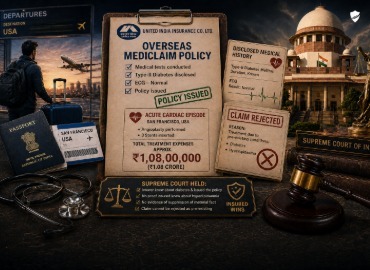
Insurance Case Study India: ₹1.08 Crore Health Claim
Health insurance claims involving pre-existing diseases often become complicated when an insurer argues that a medical condition existed before the policy was issued. However, a claim cannot be rejected merely because the insured had a known medical condition—especially when that condition was already disclosed to the insurer before the policy was issued.
This insurance case study examines Manmohan Nanda v. United India Insurance Co. Ltd., where an insured traveller disclosed his Type-II diabetes, underwent insurer-required medical tests, received an overseas mediclaim policy, and then suffered a serious cardiac event shortly after reaching the United States. His treatment expenses were approximately ₹1.08 crore, but the insurer rejected the claim citing pre-existing conditions.
The dispute ultimately reached the Supreme Court, which ruled in favour of the policyholder and held that the insurer's repudiation was not legally justified.
The ₹1.08 Crore Heart Treatment Led to an Insurance Claim
Before travelling to the United States, the policyholder applied for an Overseas Mediclaim Business and Holiday Policy from United India Insurance Company.
Because of his age and destination, he underwent medical tests required by the insurer. His medical examination specifically recorded that he had Type-II diabetes, while his ECG was reported as normal. No other adverse medical condition requiring treatment during the trip was identified. The insurer reviewed these reports and issued the policy.
On May 19, 2009, the policyholder travelled from Delhi to San Francisco. Shortly after arriving, he began feeling weak and sweating and was taken for medical treatment.
He was subsequently admitted to Mills Peninsula Medical Centre, where angioplasty was performed and three stents were inserted to treat blockages in his heart vessels.
According to submissions recorded in the Supreme Court judgment, the medical treatment charges were approximately USD 241,932, equivalent to about ₹1,08,86,940 at the exchange rate referred to in the case.
The Insurer Rejected the Claim Over Pre-Existing Conditions
After the treatment, the policyholder submitted the hospital bills and supporting documents to the insurer.
The insurer rejected the health insurance claim, relying on the policy's exclusion relating to pre-existing conditions. It argued that the insured had a history of diabetes and hyperlipidaemia and that the cardiac treatment resulted from complications associated with those conditions.
The insurer also relied on the fact that the insured had been taking statins, a type of lipid-lowering medication, to argue that he had an undisclosed medical condition.
The policyholder challenged the rejection, maintaining that he had already disclosed his diabetes and had no knowledge that he suffered from hyperlipidaemia or any pre-existing heart disease when the policy was purchased.
The National Consumer Disputes Redressal Commission initially dismissed his complaint, after which the matter reached the Supreme Court.
The Insured Had Already Disclosed His Diabetes History
The disclosure of diabetes became one of the most important facts in the dispute.
The insurer's own medical examination recorded that the policyholder had diabetes mellitus Type-II, which was controlled through medication. His ECG, blood sugar and urine tests were also examined before the policy was issued.
The Supreme Court noted that the insurer knew about the diabetes and still decided to issue the overseas mediclaim policy.
The Court also observed that diabetes may be a risk factor for cardiac disease, but that does not mean every person with diabetes will necessarily suffer a heart condition. Similarly, a person without diabetes can also suffer a cardiac event.
The judgment further noted that the available material did not establish that the insured had a pre-existing cardiac disease. His ECG before travel had been normal, and the insurer had accepted the proposal after reviewing the medical reports.
The Supreme Court Examined the Claim Rejection
The Supreme Court examined whether the policyholder had suppressed a material medical fact and whether the insurer was justified in invoking the pre-existing disease exclusion.
The Court considered:
The Supreme Court laid down an important principle: where an insurer asks for medical information, evaluates the proposer through its own medical process and issues the policy after considering the disclosed condition, it cannot later rely on that same disclosed condition to reject a claim merely because a related risk subsequently materialised.
The Court found that the insurer had been informed about the insured's diabetes and had nevertheless issued the policy. It also found no sufficient basis to conclude that the cardiac episode was an undisclosed pre-existing condition.
The Supreme Court therefore held that the repudiation was illegal and not in accordance with law. It directed the insurer to indemnify the policyholder for his medical expenses with 6% annual interest from the date the claim petition was filed, along with ₹1 lakh towards litigation costs.
What This Insurance Case Study Teaches Policyholders
This insurance case study demonstrates why complete and accurate medical disclosure is critical when purchasing health insurance.
When a known condition is disclosed and the insurer evaluates that condition before issuing the policy, it becomes difficult for the insurer to later argue that the same disclosed condition was concealed.
However, policyholders should not assume that every claim involving a disclosed condition will automatically be payable. The exact policy terms, medical evidence, disclosures and relationship between the prior condition and the subsequent treatment still matter.
The case highlights several practical lessons:
For consumers, the larger lesson is that insurance contracts depend on good faith from both sides. Policyholders must disclose material information, while insurers must fairly assess the risks they knowingly accept.
Conclusion
Health insurance claim disputes involving pre-existing diseases often depend on one critical question: was the medical condition known and properly disclosed when the policy was purchased?
In this case, the insured underwent medical examination at the insurer's instance before the overseas mediclaim policy was issued. His Type-II diabetes was specifically recorded, while his ECG was reported as normal. The insurer reviewed the information and still issued the policy. Shortly after reaching San Francisco, he suffered an acute cardiac episode requiring angioplasty and three stents, with treatment expenses of approximately ₹1.08 crore. The insurer rejected the claim citing diabetes, hyperlipidaemia and the pre-existing condition exclusion.
However, the Supreme Court found that the insurer already knew about the disclosed diabetes and had failed to establish that the cardiac episode amounted to an undisclosed pre-existing condition. The Court therefore held that the claim repudiation was illegal and directed the insurer to indemnify the policyholder.
For policyholders, this case reinforces a simple but important principle: disclose known medical conditions accurately and preserve the evidence of those disclosures.
If your health insurance claim has been rejected due to an alleged pre-existing disease, or you need guidance on policy coverage, claims review or insurance advisory, professional assistance can help you understand your options.
Contact us today or visit BasketOption.insure, the leading insurance brokers in Bangalore, for your policy, claims review, and expert advisory services. Visit https://basketoption.insure/ or get in touch with our experts today to explore insurance plans that truly care about your needs.
Latest Posts















Our Experts


Frequently Asked Questions
?What was the ₹1.08 crore health insurance case about?
The case involved a policyholder who purchased an overseas mediclaim policy before travelling to the United States. Shortly after arriving in San Francisco, he suffered a cardiac episode and underwent angioplasty with three stents. His treatment expenses were approximately ₹1.08 crore.
?Did the policyholder disclose his diabetes before purchasing the policy?
Yes. The medical examination conducted before the policy was issued specifically recorded that he had Type-II diabetes. The insurer reviewed the medical reports and still issued the policy.
?Why did the insurer reject the health insurance claim?
The insurer relied on the insured's diabetes and alleged hyperlipidaemia and argued that the cardiac treatment resulted from pre-existing conditions excluded under the policy.
?Was a heart condition detected before the policy was issued?
No pre-existing cardiac condition was established in the insurer-required medical examination. The ECG was recorded as normal before the policy was issued.
?What treatment did the policyholder receive?
He underwent angioplasty in the United States and had three stents inserted to treat blockages in his heart vessels.
?How much did the treatment cost?
The treatment charges recorded in the case were approximately USD 241,932, or about ₹1,08,86,940 at the exchange rate referred to before the Supreme Court.
?Can disclosed diabetes automatically justify rejecting a heart-treatment claim?
No. The facts, medical evidence and policy wording must be considered. In this case, the Supreme Court held that the insurer knew about the diabetes before issuing the policy and could not justify repudiation merely by linking the later cardiac event to that disclosed condition.
?What did the Supreme Court ultimately order?
The Supreme Court directed the insurer to indemnify the insured for the medical expenses, with interest at 6% per annum from the date of filing the claim petition until payment. It also awarded ₹1 lakh towards litigation costs.
?What should policyholders learn from this insurance case study?
Policyholders should disclose known medical conditions accurately, preserve proposal forms and medical reports, understand pre-existing disease clauses, retain all claim documents and carefully examine the reasons given when a claim is rejected.
?What is the key takeaway from this case?
The key takeaway is that once an insurer has been informed of a medical condition, evaluated it and issued the policy, it cannot later treat that same disclosed condition as if it had been concealed without sufficient evidence and contractual justification.