Jayanagar 3rd Block East Bangalore-560011, Karnataka India

Insurance Case Study India: ₹78 Lakh Coal Fire: Insurer Ordered to Pay
Insurance Case Study India: ₹78 Lakh Coal Fire: Insurer Ordered to Pay
A marine cargo insurance claim can become complicated when a loss occurs while goods are temporarily stored during transit and the insurer argues that the insurance coverage has already ended.
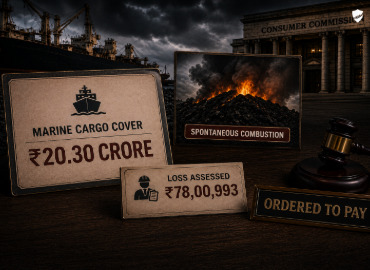
This case involved Hind Energy and Coal Benefication (India) Ltd., which had insured imported steam coal under a Marine Cargo Open Cover. The coal was transported from Indonesia to India and was stored at Dhamra Port before reaching its final destination.
On 14 May 2012, the stored coal caught fire due to spontaneous combustion. The company reported the incident to its insurer, which appointed a surveyor to investigate the loss.
The surveyor assessed the loss at ₹78,00,993, but the insurance company rejected the claim.
The dispute eventually reached the Chhattisgarh State Consumer Disputes Redressal Commission, raising an important question: Was spontaneous combustion during intermediate storage actually covered by the marine cargo insurance policy?
The Coal Fire Triggered a ₹78 Lakh Marine Insurance Claim
Hind Energy and Coal Beneficiation (India) Ltd. was engaged in the coal business and imported coal from overseas.
The company had obtained a Marine Cargo Open Cover for the transportation of steam coal. For the consignment involved in this case, the coal was transported from Muara Satui, Indonesia, to India, with the final destination stated as the railway siding at Gatora, Bilaspur.
The total insured cargo value was eventually increased to ₹20,30,95,200.
The coal reached Dhamra Port in Odisha in April 2012 and was unloaded and transported to a storage plot at the port.
On 14 May 2012, while the coal was still stored at Dhamra Port, it caught fire due to spontaneous combustion.
The company stated that the incident resulted in a loss of approximately ₹96.28 lakh and informed the insurance company about the loss.
The insurer then appointed Mack Surveyors Pvt. Ltd. to inspect the damage and assess the marine cargo insurance claim.
The Insurer Rejected the Claim Over Coverage Conditions
Despite the loss being investigated by its appointed surveyor, the insurance company subsequently repudiated the claim.
The insurer argued that the marine transit insurance had already terminated.
According to the insurer, once the coal was unloaded and stored at leased plots at Dhamra Port for allocation or distribution, the ordinary transit had ended. Therefore, the fire that occurred approximately one month later was outside the applicable insurance coverage.
The insurer also relied on the inherent vice exclusion.
Its position was that coal had caught fire because of its inherent nature through self-ignition or spontaneous combustion and that such a loss was excluded under the applicable Institute Cargo Clauses.
The insured company disagreed.
It argued that the insurance arrangement provided wider coverage, including intermediate storage and spontaneous combustion, and that additional premium had been paid for the agreed coverage.
This disagreement over the scope of the policy became central to the cargo insurance claim dispute.
Spontaneous Combustion Was Included in the Insurance Cover
The quotation slip became an important document in deciding the spontaneous combustion insurance claim.
The Commission found that the quotation slip formed an integral part of the insurance policy.
Importantly, its terms specifically stated that loss due to spontaneous combustion was covered.
The agreed terms also provided intermediate storage coverage against fire and allied perils, including spontaneous combustion, for 60 days at specified locations such as port locations, port city locations and railway sidings.
The Commission also examined the duration provision of the policy.
The coal had been unloaded in April 2012 and caught fire on 14 May 2012. Therefore, the incident occurred within the relevant 60-day period.
The Commission concluded that merely storing the coal at Dhamra Port did not establish that it had reached its final destination.
As a result, the Commission held that the insurance policy remained in existence when the coal caught fire.
The additional premium was also significant because the Commission considered its collection as evidence that the insurer had accepted the additional risks contemplated by the wider coverage.
The Surveyor Assessed the Loss at ₹78 Lakh
The surveyor report in the insurance claim became another critical part of the dispute.
The insurance company itself had appointed Mack Surveyors Pvt. Ltd. to investigate the incident.
After inspecting and assessing the loss, the surveyor concluded that the coal fire had resulted from spontaneous combustion.
The surveyor assessed the loss at ₹78,00,993 after making the relevant deductions.
Importantly, the surveyor also reported that no breach of the policy's terms, conditions or warranties had been observed.
The insurer disagreed with this conclusion but did not produce another survey report or sufficient evidence to rebut the assessment.
The Commission considered established principles concerning the importance of surveyor reports in deciding insurance claims and found no sufficient reason to discard the report in this case.
As a result, the surveyor's assessment of ₹78,00,993 became the basis for determining the amount payable.
Why the Commission Ordered the Insurance Company to Pay
After examining the policy documents, quotation slip, additional coverage and surveyor's findings, the Commission partly allowed the complaint.
It concluded that spontaneous combustion was included within the insurance arrangement and that the fire occurred while the relevant coverage was still in force.
The insurer was therefore directed to pay ₹78,00,993 to Hind Energy and Coal Beneficiation (India) Ltd. within two months from the date of the order.
The Commission further directed that if the amount was not paid within the stipulated period, the company would be entitled to interest at 9% per annum on the amount.
An additional ₹10,000 towards litigation costs was also awarded.
This insurance claims case study demonstrates why every document forming part of a commercial insurance arrangement can become important during a claim dispute.
The policy schedule alone may not always tell the complete coverage story. Quotations, placement slips, endorsements, extensions, additional premiums and surveyor reports can all become crucial when determining whether a particular loss falls within the agreed insurance protection.
Conclusion
Marine cargo insurance claim disputes often depend on the exact wording of the policy, endorsements, quotation documents and additional covers purchased by the insured.
In this case, Hind Energy and Coal Beneficiation (India) Ltd. had insured imported steam coal under a Marine Cargo Open Cover. After the coal reached Dhamra Port, it was stored at the port before completing its journey. On 14 May 2012, the coal caught fire due to spontaneous combustion.
The insurer-appointed surveyor investigated the incident and assessed the loss at ₹78,00,993. The surveyor also reported that no breach of the policy's terms, conditions or warranties had been observed.
The insurance company nevertheless rejected the claim, arguing that the marine transit insurance had already ended and that the loss resulted from the inherent nature of coal.
The Commission disagreed.
The insurance documents showed that spontaneous combustion was included in the agreed coverage and that intermediate storage against fire and spontaneous combustion was covered for 60 days. Since the incident occurred within the relevant period and before the cargo reached its final destination, the Commission held that the policy remained in existence.
The insurer was consequently directed to pay ₹78,00,993 within two months, with 9% annual interest applicable if payment was delayed beyond the stipulated period. It was also directed to pay ₹10,000 towards litigation costs.
This case highlights an important lesson: insurance coverage should be understood from the complete set of agreed policy documents rather than from one clause viewed in isolation.
Businesses should carefully retain policy schedules, quotation slips, endorsements, premium records and surveyor reports because these documents can become critical when a commercial insurance claim is disputed.
If your business depends on the transportation or storage of valuable goods, understanding the exact scope of your marine cargo insurance can help identify potential coverage gaps before a loss occurs.
Professional insurance advisory can also help businesses understand policy conditions, extensions, exclusions, transit limits and storage coverage.
Contact us today or visit BasketOption.insure, the leading insurance brokers in Bangalore, for your policy, claims review, and expert advisory services. Visit https://basketoption.insure/ or get in touch with our experts today to explore insurance plans that truly care about your needs.
Latest Posts










Our Experts


Frequently Asked Questions
?What was the ₹78 lakh coal insurance case about?
The case involved imported steam coal covered under a Marine Cargo Open Cover. The coal caught fire due to spontaneous combustion while stored at Dhamra Port, resulting in a disputed marine cargo insurance claim.
?What caused the coal fire?
The insurer-appointed surveyor reported that the fire was caused by spontaneous combustion. The survey report also referred to hot and dry weather conditions during storage and found no foul play.
?How much was the original loss?
The insured company stated that the coal fire caused a loss of approximately ₹96.28 lakh.
?How much did the surveyor assess as payable loss?
The insurer-appointed surveyor assessed the loss at ₹78,00,993 after relevant deductions.
?Why did the insurance company reject the claim?
The insurer argued that the marine transit cover had ended once the coal was stored at Dhamra Port for allocation or distribution. It also relied on an exclusion relating to loss caused by the inherent nature or vice of the insured cargo.
?Was spontaneous combustion covered?
The Commission found that the quotation slip forming part of the insurance arrangement specifically included loss due to spontaneous combustion.
?Why was the 60-day storage coverage important?
The agreed terms included intermediate storage against fire, allied perils and spontaneous combustion for 60 days at specified locations. The Commission found that the fire occurred within the relevant period.
?Why did the Commission rely on the surveyor's report?
The surveyor was appointed by the insurer and assessed the loss at ₹78,00,993. The Commission noted that the insurer had not produced sufficient evidence or another survey report to rebut the assessment.
?How much was the insurer ordered to pay?
The Commission directed the insurance company to pay ₹78,00,993 within two months. If payment was not made within that period, 9% annual interest would apply. The insurer was also ordered to pay ₹10,000 towards litigation costs.
?What is the key lesson from this marine cargo insurance case?
Businesses should understand the complete scope of their insurance coverage and retain all supporting documents. Policy schedules, quotation slips, extensions, endorsements, premium records and surveyor reports can become critical evidence when an insurance claim is disputed.