Jayanagar 3rd Block East Bangalore-560011, Karnataka India

Insurance Case Study in India: ₹22 Crore Fire Claim Rejected
Insurance Case Study in India: ₹22 Crore Fire Claim Rejected
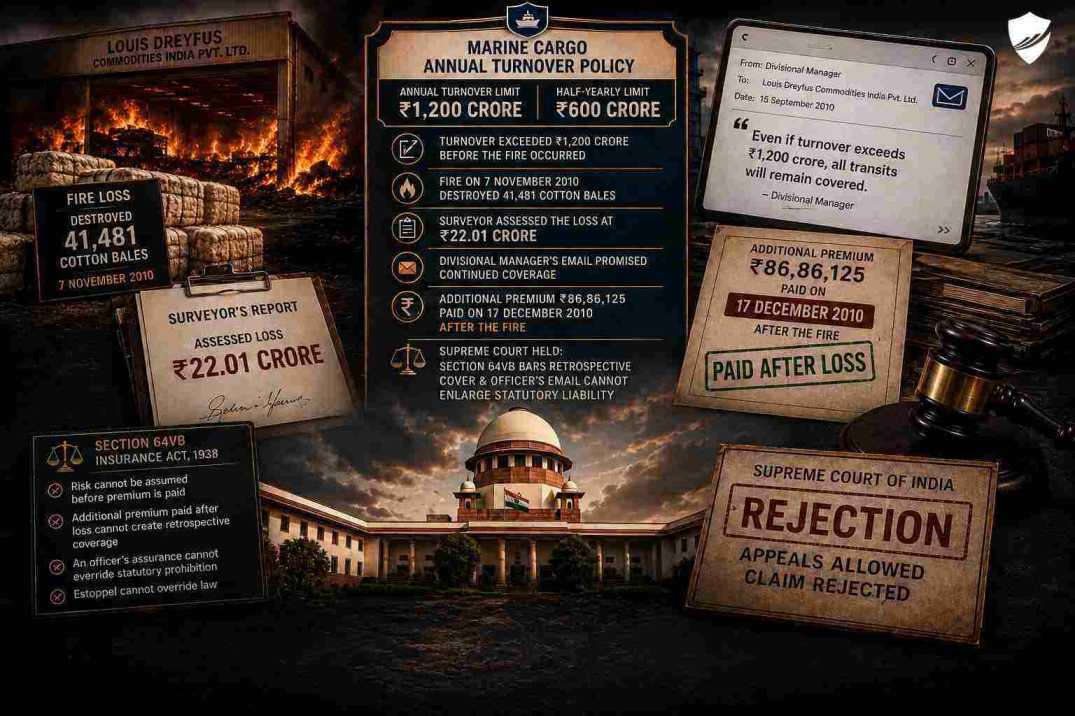
A ₹22.01 crore fire loss, thousands of cotton bales, an assurance from an insurance company official, and an additional premium paid after the accident eventually resulted in a major insurance claim rejection before the Supreme Court.
The dispute involved a Marine Cargo Annual Turnover Policy issued by an insurer. Although the policy was valid when the fire occurred, the central question was whether the increased business turnover was actually covered when the loss took place.
The case ultimately highlighted an important insurance principle: a policy being active does not necessarily mean that every increased exposure is automatically covered.
The ₹22 Crore Fire Loss Triggered an Insurance Claim
The policyholder had obtained a Marine Cargo Annual Turnover Policy covering an expected annual turnover of ₹1,200 crore. The premium was payable in two equal installments.
On November 7, 2010, a fire broke out at a Container Freight Station where 41,481 cotton bales belonging to the insured company were stored.
The insurer was informed about the incident, and a surveyor was appointed to assess the damage. The surveyor eventually assessed the net fire loss at approximately ₹22.01 crore.
However, the insurance claim soon developed into a dispute.
The insurer argued that the company's turnover had already crossed the ₹1,200 crore insured turnover limit months before the fire. By the date of the incident, the turnover was stated to have reached approximately ₹1,724.12 crore.
According to the insurer, the premium corresponding to the original insured turnover had therefore already been exhausted, while no additional premium had been paid to cover the increased exposure.
The Manager's Promise Became Central to the Coverage Dispute
The policyholder relied heavily on an earlier communication from the insurer's Divisional Manager.
In May 2010, the Divisional Manager had indicated that once the second premium instalment was paid, the transits would remain covered until the expiry of the policy even if turnover crossed ₹1,200 crore.
The policyholder therefore argued that insurance coverage continued despite the increased turnover. This communication became an important part of the insurance contract dispute.
However, another critical development occurred after the fire. The insurer sought an additional premium of ₹86,86,125 in December 2010 to enhance the coverage. The additional premium was paid on December 17, 2010—more than a month after the fire had already occurred.
An endorsement enhancing the coverage was subsequently issued from that date.
The dispute therefore raised an important question: could an officer's earlier assurance or a premium paid after the loss retrospectively create insurance coverage?
The Supreme Court Examined Premium Payment and Insurance Coverage
The dispute eventually reached the Supreme Court after the National Consumer Disputes Redressal Commission had ruled in favour of the policyholder.
A major issue before the Supreme Court was the application of Section 64VB of the Insurance Act, 1938. The provision restricts an insurer from assuming risk unless the required premium has been received in advance or secured in the legally permitted manner.
The Court examined several important factors:
The Court concluded that the insured turnover had already been exceeded well before the fire occurred.
Since the additional premium for the increased exposure had not been paid before the loss, the increased risk could not be retrospectively covered merely because an insurer's officer had earlier given an assurance.
The Supreme Court Rejected the ₹22 Crore Insurance Claim
The Supreme Court allowed the appeals filed by New India Assurance and set aside the NCDRC's decision directing payment of the fire-loss claim.
The Court held that the additional risk could not be assumed contrary to Section 64VB when the corresponding premium had not been paid or appropriately secured before the loss.
The Court also rejected the argument that the Divisional Manager's communication could independently expand the insurer's liability beyond what was legally permissible.
The additional premium paid on December 17, 2010 also could not retrospectively cover the fire that had already occurred on November 7.
Therefore, despite the surveyor assessing the physical loss at approximately ₹22.01 crore, the insurance claim was ultimately rejected because the required additional coverage was not operative on the date of the fire.
What This Insurance Case Study in India Reveals About Coverage Without Premium
This insurance case study provides an important lesson for businesses whose insurance exposure changes during the policy period.
A policy may technically remain within its stated policy period, but businesses must also ensure that the limits, turnover declarations, premiums, endorsements, and actual exposures remain aligned.
Rapidly growing businesses can face significant underinsurance risks if turnover, inventory, cargo movement, property values, or other exposures increase without corresponding changes to their insurance arrangements.
The case also demonstrates why policyholders should not rely solely on informal assurances from insurance representatives. Any material enhancement in coverage should be properly documented, endorsed, and supported by the required premium before the increased risk arises.
Conclusion
Insurance coverage depends not only on the policy period but also on the limits of the risk actually insured and the premium paid for that risk. In this case, the fire caused a loss assessed at approximately ₹22.01 crore, but the insured turnover limit had already been exceeded before the incident. The additional premium required for enhanced coverage was paid only after the fire.
The Supreme Court held that Section 64VB of the Insurance Act prevents an insurer from assuming additional risk before the corresponding premium is received or otherwise secured as permitted by law. An assurance from an insurer's officer could not override that statutory requirement or retrospectively enlarge the insurance coverage.
For businesses, the case highlights the importance of regularly reviewing policy limits, monitoring turnover and changing exposures, and arranging additional coverage before existing insurance limits become inadequate.
A policy can exist on paper and still leave a business inadequately protected if its actual exposure has grown beyond the insured limits.
If you are unsure whether your current insurance limits adequately cover your business risks, or need expert guidance on policy coverage, claim disputes, or insurance reviews, our specialists can help you identify potential gaps before a loss occurs.
Contact us today or visit BasketOption.insure, the leading insurance brokers in Bangalore, for your policy, claims review, and expert advisory services. Visit https://basketoption.insure/ or get in touch with our experts today to explore insurance plans that truly care about your needs.
Latest Posts











Our Experts


Frequently Asked Questions
?What was the ₹22 crore insurance claim dispute about?
The dispute arose after a fire damaged cotton bales belonging to the insured company. Although the surveyor assessed the loss at approximately ₹22.01 crore, the insurer argued that the company's turnover had already exceeded the ₹1,200 crore insured turnover limit before the fire.
?Why was the ₹22 crore insurance claim rejected?
The insured turnover limit had been exceeded before the fire, while the additional premium required for enhanced coverage had not been paid before the loss occurred.
?What did the insurer's Divisional Manager say?
The policyholder relied on an earlier communication indicating that after payment of the second premium instalment, transits would remain covered until expiry of the policy even if turnover exceeded ₹1,200 crore.
?Why did the Supreme Court not accept the manager's assurance?
The Supreme Court held that an insurer's employee could not expand the insurer's liability in a manner contrary to the statutory requirements governing assumption of risk and payment of premium.
?What is Section 64VB of the Insurance Act?
Section 64VB of the Insurance Act, 1938 generally prevents an insurer from assuming risk unless the required premium has been received in advance or appropriately secured as permitted by law.
?When was the additional premium paid?
The additional premium of ₹86,86,125 was paid on December 17, 2010, while the fire had occurred on November 7, 2010.
?Can additional insurance coverage apply retrospectively?
The Supreme Court held in this case that the subsequent premium payment and endorsement could not retrospectively extend the additional coverage to a loss that had already occurred.
?What did the Supreme Court ultimately decide?
The Supreme Court allowed New India Assurance's appeals and set aside the NCDRC order that had directed payment of the fire-loss claim. The Court concluded that the additional coverage was not operative when the fire occurred.
?What lessons does this insurance case study teach businesses?
Businesses should regularly monitor turnover and other changing exposures, review insurance limits, arrange additional coverage before limits are exhausted, pay required premiums on time, obtain formal endorsements, and avoid relying solely on informal assurances regarding coverage.
?Why is adequate insurance coverage important for businesses?
A business's exposure can increase significantly during a policy period. If turnover, inventory, cargo values, property values, or other exposures exceed the insured limits without corresponding enhancement of coverage, a major loss may not be fully covered.