Jayanagar 3rd Block East Bangalore-560011, Karnataka India

Insurance Case Study: No Disease Proof, ₹20L Ordered
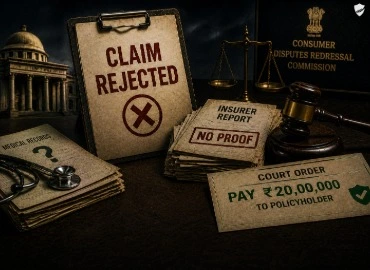
Insurance Case Study: No Proof of Disease… Yet Claim Rejected? Court Orders ₹20 Lakh Payout
Health insurance is meant to provide financial protection during medical emergencies and difficult times. However, disputes often arise when insurers reject claims by alleging pre-existing diseases or non-disclosure of medical conditions. In this insurance case study, a major health insurance dispute reportedly emerged after an insurer rejected a claim by alleging that the insured suffered from a pre-existing disease. The family, however, reportedly argued that there was no medical proof supporting the allegation. The dispute eventually reached court, where the insurer's rejection reportedly came under detailed scrutiny. The case became an important example of how courts examine medical evidence, policy exclusions, and claim rejection practices in health insurance disputes.
Insurance Company Rejected the Claim Over an Alleged Disease
According to reports surrounding the dispute, the insured person had obtained health insurance coverage and later required medical treatment that resulted in a substantial claim under the policy.
However, the insurance company reportedly denied the claim by alleging that:
Such claim denials can create severe emotional and financial distress for families already dealing with medical emergencies or loss. The family, however, reportedly strongly disputed the insurer's allegations.
Family Argued There Was No Proof of Any Pre-Existing Illness
The nominee and family members reportedly argued that:
Consumer forums and courts in India have repeatedly observed that insurers bear the burden of proving suppression or concealment when rejecting claims on pre-existing disease grounds.
The disagreement soon escalated into a major health insurance legal dispute.
Health Insurance Dispute Escalated Into a Legal Battle
After the rejection, the family reportedly approached the appropriate legal forum seeking compensation under the insurance policy.
The dispute reportedly focused on several critical issues:
Court Examined Medical Records, Evidence, and Policy Terms
During the proceedings, the court reportedly reviewed:
Courts have repeatedly observed that insurers cannot rely solely on assumptions or vague allegations while rejecting health insurance claims.
The proceedings reportedly focused on whether there was credible documentary evidence, whether the rejection was reasonable and justified, and whether consumer rights were violated through wrongful claim denial.
Court Ordered ₹20 Lakh Payout in Favor of the Claimant
According to the reported outcome, the court reportedly ruled against the insurer and directed payment of approximately ₹20 lakh to the claimant.
The ruling reportedly emphasized that:
Several judicial decisions and consumer forum rulings have reinforced the principle that unsupported allegations cannot justify denial of genuine health insurance claims.
What This Insurance Case Study Reveals About Claim Rejections
This insurance case study offers important lessons for policyholders and families.
| # | Key Lesson | What It Means |
|---|---|---|
| 1 | Insurers Must Prove Allegations Properly | Claim rejections based on pre-existing disease allegations require credible medical evidence. |
| 2 | Medical Documentation Is Extremely Important | Medical records, prescriptions, and hospital reports play a major role in claim disputes. |
| 3 | Policyholders Should Understand Policy Terms | Awareness of exclusions, waiting periods, and disclosure obligations is essential. |
| 4 | Wrongful Claim Rejections Can Be Challenged | Consumer forums and courts may provide relief if insurers reject claims unfairly. |
| 5 | Consumer Rights Matter in Insurance Disputes | Courts often examine whether the insurer acted fairly, reasonably, and in good faith. |
Conclusion
This insurance case study involving a rejected health insurance claim highlights how disputes over alleged pre-existing diseases can become major legal battles.
Health insurance claims should be rejected only on the basis of clear medical evidence and valid policy exclusions. Policyholders and families must understand their rights and challenge unfair claim denials when necessary.
At BasketOption.insure, we believe every genuine health insurance claim deserves fair treatment. Our experts help you understand your coverage, challenge wrongful rejections, and navigate health insurance disputes. Visit https://basketoption.insure/ or get in touch with our experts today to explore insurance plans that truly care about your needs.
Latest Posts




Our Experts


Frequently Asked Questions
Know your health insurance rights. Challenge unfair rejections. Stay covered.
?What is a health insurance claim rejection?
A health insurance claim rejection occurs when the insurer refuses to pay medical expenses claimed under the policy.
?What is a pre-existing disease in health insurance?
A pre-existing disease refers to a medical condition, illness, or injury that existed before purchasing the insurance policy.
?Can insurers reject claims without proof of pre-existing disease?
Courts and consumer forums have repeatedly held that insurers must provide proper medical evidence before rejecting claims on the basis of pre-existing disease allegations.
?What documents are important in health insurance disputes?
Important documents include medical records, hospital reports, policy documents, diagnostic reports, prescriptions, and claim correspondence.
?Why do insurers reject health insurance claims?
Claims may be rejected due to alleged non-disclosure, policy exclusions, waiting periods, documentation issues, or suspicion of concealment.
?Can policyholders legally challenge rejected health insurance claims?
Yes, policyholders or nominees may approach consumer forums, ombudsmen, or courts if they believe the rejection was unfair.
?What factors do courts examine in health insurance disputes?
Courts generally examine medical evidence, policy wording, alleged concealment, and whether the insurer acted reasonably.
?What lessons does this insurance case study teach policyholders?
This case highlights the importance of proper documentation, accurate disclosures, understanding policy terms, and challenging unsupported rejections.
?Can common illnesses automatically justify claim rejection?
Consumer forums have repeatedly observed that common illnesses alone cannot justify claim rejection unless insurers prove material non-disclosure and direct relevance to the claim.
?Why are health insurance case studies important?
These case studies help policyholders understand real-world insurance disputes, consumer rights, insurer obligations, and legal interpretation of health insurance policies.