Jayanagar 3rd Block East Bangalore-560011, Karnataka India

Insurance Case Study: AI Cut ₹1.6 Crore Hospital Bill
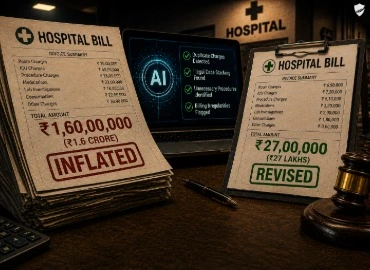
Insurance Case Study: ₹1.6 Crore to ₹27 Lakhs — How AI Crushed an Inflated Hospital Bill
Health insurance claims are designed to provide financial relief during medical emergencies. However, disputes can arise when insurers suspect that hospital bills contain inflated charges, duplicate entries, or questionable billing practices. In this insurance case study, a hospital bill reportedly escalated to nearly ₹1.6 crore before an AI-powered review allegedly identified major discrepancies in the billing process. After detailed analysis, the disputed amount reportedly dropped to around ₹27 lakhs, triggering widespread discussions around AI in insurance claims, medical billing transparency, and fraud detection. The case became a major example of how artificial intelligence and data analytics are increasingly transforming insurance claim investigations and healthcare billing audits.
The Hospital Bill Shocked Everyone — Until AI Reviewed It
According to reports surrounding the dispute, the patient underwent extensive medical treatment that generated an extremely large hospital bill reportedly exceeding ₹1.6 crore.
The amount allegedly raised concerns because:
In major health insurance claims, insurers frequently conduct detailed reviews to verify whether the billed amount accurately reflects the treatment provided.
The unusually large amount reportedly triggered a deeper insurance claim investigation involving AI-powered analysis tools.
Insurance Claim Investigation Uncovered Inflated Medical Charges
As part of the review process, the insurer or auditing system reportedly used AI-based tools to analyze thousands of billing entries and treatment records.
AI-powered insurance claim review systems are increasingly used to:
Insurance fraud detection systems using AI and analytics are becoming more common because manual claim reviews may struggle to process highly complex billing data efficiently.
The dispute reportedly became a major example of how technology can reshape medical billing verification and insurance claim assessments.
AI-Powered Audit Challenged the Hospital's Billing Practices
Following the AI-based review, the hospital billing reportedly came under intense scrutiny.
Medical billing disputes often arise due to:
Hospitals and insurers frequently disagree in such cases because hospitals may defend charges based on treatment complexity, insurers may question whether certain expenses were medically necessary, and billing standards and interpretations may differ.
The dispute highlighted how AI tools can assist insurers by rapidly analyzing large datasets, billing structures, treatment patterns, and historical claim comparisons.
AI-driven systems are increasingly being explored to improve insurance fraud detection, medical billing transparency, claim settlement efficiency, and cost control in healthcare insurance.
The review reportedly resulted in a dramatic reassessment of the payable amount.
Claim Settlement Changed After Detailed Billing Analysis
According to reports surrounding the case, the disputed hospital bill reportedly reduced from approximately ₹1.6 crore to nearly ₹27 lakhs after the AI-assisted review process.
The significant reduction allegedly occurred after:
Many experts believe that AI-based audits may help reduce fraudulent claims, improve fairness in claim settlements, detect anomalies faster, enhance claim accuracy, and control rising healthcare costs.
At the same time, the case also raised questions about billing practices in hospitals, oversight mechanisms, ethical healthcare pricing, and the role of technology in insurance investigations.
The matter became a widely discussed insurance and healthcare case study involving AI-powered claim review.
Lessons From This AI-Based Insurance Fraud Detection Case Study
This insurance case study offers several important lessons for insurers, hospitals, and policyholders.
| # | Key Lesson | What It Means |
|---|---|---|
| 1 | AI Is Transforming Insurance Claim Investigations | Automated systems can identify anomalies and billing inconsistencies much faster than manual reviews. |
| 2 | Medical Billing Transparency Is Extremely Important | Patients and insurers increasingly expect clear, verifiable, and justified billing structures. |
| 3 | Duplicate and Inflated Charges Can Trigger Major Disputes | Billing irregularities may lead to claim reassessment and fraud investigations. |
| 4 | Policyholders Should Review Medical Bills Carefully | Patients should preserve invoices, records, and treatment documents while reviewing unexplained charges. |
| 5 | Technology Is Reshaping Healthcare Accountability | AI and analytics are becoming powerful tools in healthcare cost management and insurance fraud detection. |
Conclusion
This insurance case study involving a massive hospital bill reduction demonstrates how AI and data analytics are changing the future of insurance claim investigations and healthcare billing verification.
AI and data analytics are transforming insurance claims by helping detect inflated medical bills, duplicate charges, and suspicious billing practices. Policyholders and insurers alike must prioritize transparency, verification, and ethical healthcare billing.
At BasketOption.insure, we stay ahead of the latest developments in insurance technology and claims management. Whether you need health insurance guidance, claim dispute support, or expert advice on billing transparency, our team is here. Visit https://basketoption.insure/ or get in touch with our experts today to explore insurance plans that truly care about your needs.
Latest Posts







Our Experts


Frequently Asked Questions
Understand AI in insurance. Know your billing rights. Stay protected.
?What is an inflated hospital bill case?
An inflated hospital bill case involves allegations that medical charges were exaggerated, duplicated, or unnecessarily increased beyond reasonable treatment costs.
?How is AI used in insurance claims?
AI is increasingly used to detect duplicate billing, suspicious claim patterns, unusual medical charges, and coding inconsistencies during claim reviews.
?What is hospital billing fraud detection?
Hospital billing fraud detection involves identifying suspicious or false billing practices through audits, analytics, investigations, and AI-based review systems.
?Why do health insurance billing disputes arise?
Disputes may arise due to inflated treatment charges, duplicate billing, coding discrepancies, unnecessary procedures, or disagreements over covered expenses.
?Can AI reduce inflated insurance claims?
AI tools can help insurers identify anomalies and inconsistencies that may significantly reduce disputed or inflated claim amounts.
?What documents are important in medical billing disputes?
Important documents include hospital bills, treatment records, diagnostic reports, insurance policy documents, invoices, and audit findings.
?Can hospitals and insurers dispute medical bill amounts?
Yes, insurers may challenge suspicious billing practices while hospitals may defend charges based on treatment complexity and medical necessity.
?What lessons does this insurance case study teach policyholders?
This case highlights the importance of reviewing bills carefully, preserving records, understanding insurance coverage, and questioning unexplained charges.
?What role does AI play in insurance fraud detection?
AI can detect duplicate claims, billing manipulation, suspicious treatment patterns, and unusual financial activity during claims processing.
?Why are AI-based insurance case studies important?
These case studies help insurers, hospitals, and policyholders understand how technology is reshaping fraud detection, billing transparency, healthcare accountability, and insurance investigations.